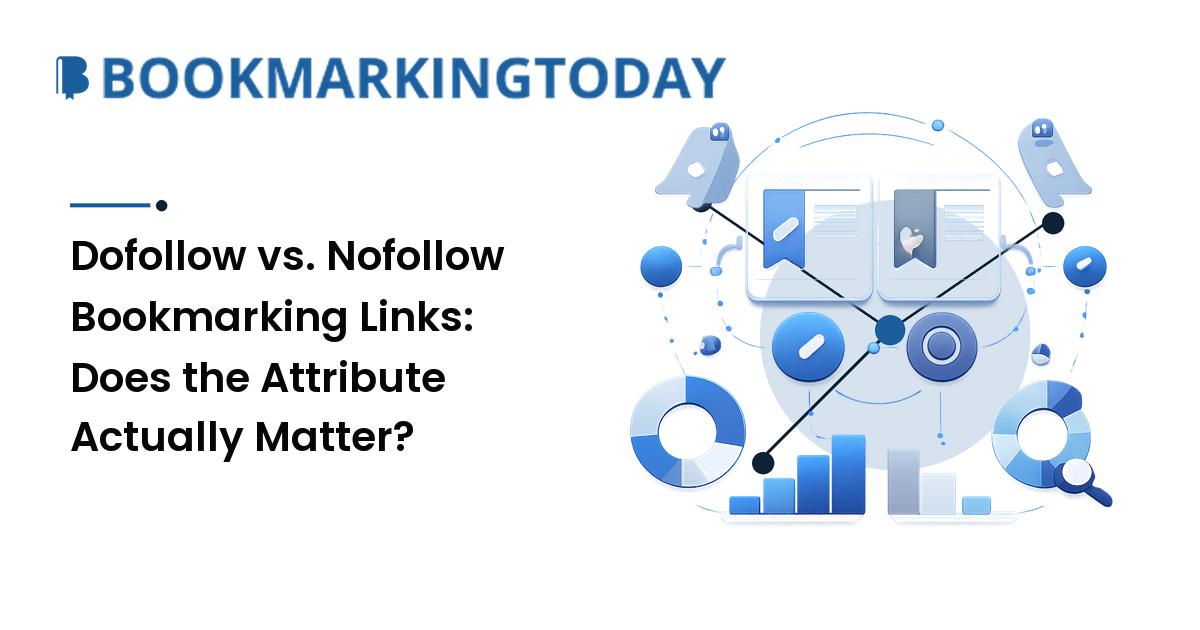
Open any "best social bookmarking sites" list and one column does all the heavy lifting: Dofollow? Yes or no. The implied logic is that "Yes" rows are worth your time and "No" rows are a waste — so people filter for dofollow, submit only there, and ignore the rest, convinced they've optimized.
The takeaway up front: for bookmarking links, the dofollow-versus-nofollow distinction is one of the least useful ways to choose where to submit. The attribute tells you how a link is marked up, not whether it will do anything for you. Most bookmarking links are nofollow by design, the few that aren't rarely carry the authority people imagine, and Google stopped treating "nofollow" as a hard rule years ago. Choose platforms by who reads them, not by a tag in the HTML — and the link value sorts itself out.
What "dofollow" and "nofollow" actually mean
There is no dofollow attribute. "Dofollow" is just shorthand for a normal link with nothing special added — the default state of any <a href>. The thing that actually exists is rel="nofollow", an attribute a site adds to a link to signal that it doesn't necessarily vouch for the destination.
That distinction matters because of how the web is built. The moment a platform lets users post links, it becomes a target for people chasing links purely to manipulate rankings. Adding nofollow to user-submitted links is the standard defense: it lets the platform host your link without staking its own reputation on it. That's why the overwhelming majority of bookmarking, forum, profile, and comment links are nofollow — it's blanket policy applied to everything users post, not the platform judging your content.
Two related attributes show up in the same context for the same reason:
rel="ugc"— marks user-generated content (the natural label for a bookmark or comment link).rel="sponsored"— marks paid or promotional links.
For practical purposes, treat all three as the same category: the platform is telling search engines this link was placed by a user, not editorially endorsed by the site.
Why most bookmarking links are nofollow — and why that's fine
If you've gone looking for dofollow bookmarking sites, you've probably noticed the pickings are thin — and the ones advertising "dofollow links!" tend to be exactly the low-moderation, link-anyone platforms you should be most wary of. That isn't a coincidence. A platform with strong spam controls has every reason to nofollow user submissions; a platform desperate for submissions dangles dofollow as bait. The attribute you were optimizing for is, more often than not, a marker of the weakest places to submit.
Here's the reframe that fixes the whole problem. The value of a bookmarking link was never mainly about passing ranking signal. It comes from two things, and the attribute touches neither:
- Referral traffic — a real person sees your saved page and clicks through. A nofollow link sends that visitor exactly as well as a dofollow one; the attribute is invisible to humans.
- Discovery and reach — your content gets surfaced to an audience, re-shared, maybe picked up by someone who later links to you from their own site (the link that actually builds authority). Nofollow doesn't dampen any of that.
So a nofollow bookmark on a platform with a relevant, active audience is worth far more than a dofollow link on a dead, spammy one. We unpack this honest model of bookmarking's real SEO role in the SEO link building guide; the short version is that bookmarking earns its keep through reach and referrals, neither of which depends on the link attribute.
Does nofollow still matter to Google at all?
Yes, but not the way the old "nofollow blocks link juice" rule of thumb suggests. Google changed how it treats the attribute: nofollow, ugc, and sponsored are now hints rather than strict directives. Google may consider a nofollow link for ranking if it judges that useful, and generally won't follow these links for crawling.
Don't over-read that. "May consider as a hint" is a long way from "passes authority like an editorial link." Practically, you can't assume a nofollow link does nothing (it might count as a weak signal you can't see), and you equally can't bank on it building authority. Building a strategy around squeezing ranking power out of nofollow bookmarks is building on sand. Whether a link helps depends on relevance and real engagement, not three letters in the markup.
There's a second reason chasing dofollow backfires. A healthy backlink profile is naturally a mix of followed and nofollowed links from many kinds of sources. A profile that's all dofollow, all exact-match, all from link-anyone platforms is the pattern that looks engineered — so at scale, optimizing for the attribute can make your links look less natural, not more.
How to choose bookmarking platforms instead
If link attribute is the wrong filter, here's the one that predicts value. Run each platform through these questions, and let the answers — not the "Dofollow?" column — decide where you submit.
- Is there a real, relevant audience here? Do people in your niche actually browse, save, and click on this platform? If a real reader would never see your link, the attribute is irrelevant — nothing sends traffic that isn't there.
- Is it moderated? Light spam controls usually mean a cleaner platform, a more engaged audience, and submissions that don't get buried. Heavy nofollow-everything policies often travel with good moderation — that's a feature, not a flaw.
- Does the submission allow a genuine description? Platforms that let you write a real title and summary reward effort with engagement. Those that only want a URL and an exact-match anchor are built for volume, not readers.
- Would you submit here if links passed zero ranking signal? The honest gut check. If the only reason to use a platform is a rumored dofollow link, skip it. If you'd use it anyway for the audience, submit — and treat any SEO benefit as a bonus.
Notice that "Is it dofollow?" never appears. A platform that passes these four questions is worth submitting to whether its links are followed or not; one that fails them isn't worth it even if every link is dofollow.
FAQ
Are dofollow links better than nofollow links for SEO?
In a vacuum, an editorial dofollow link from a relevant, trusted site does more for authority than a nofollow one. But that's not the choice you face with bookmarking. Bookmarking links are overwhelmingly nofollow, and their value comes from referral traffic and discovery — which a nofollow link delivers just as well. Sorting platforms by attribute optimizes the wrong variable.
Do nofollow bookmarking links count for anything?
They can. Google treats nofollow as a hint it may consider rather than a hard block, so the link isn't guaranteed to be ignored — but it's also not guaranteed to pass authority. More importantly, nofollow links still drive real visitors and surface your content to people who might link to you from their own sites later. That indirect value is the part that actually matters.
Should I only submit to dofollow social bookmarking sites?
No, and filtering that way tends to backfire. The platforms that loudly advertise dofollow links are often the low-moderation, spam-prone ones with little real audience, while many of the best-moderated, most-engaged platforms nofollow everything by policy. Sort by audience and moderation instead.
How can I tell if a bookmarking link is dofollow or nofollow?
View the page source or use a browser extension that highlights nofollow links, and look for rel="nofollow", rel="ugc", or rel="sponsored" on your link. It's worth being able to check — just not worth optimizing around.
Does a mix of dofollow and nofollow links look more natural?
Yes — real sites accumulate both, because that's how people link on the open web. A profile that's entirely dofollow exact-match links from submission sites looks manufactured. You don't need to engineer a ratio: using platforms for their audience rather than their attribute produces a natural mix on its own.
Next step
Delete the "Dofollow?" column from your platform shortlist. It optimizes a variable that doesn't move the outcome: a nofollow link on a relevant, well-moderated platform sends real visitors and gets your content discovered, while a dofollow link on a dead spam site does neither. Pick where you submit by who actually reads it, write a description worth clicking, and let any ranking benefit be the bonus it was always meant to be. Start choosing platforms by audience, not attribute, at BookmarkingToday.