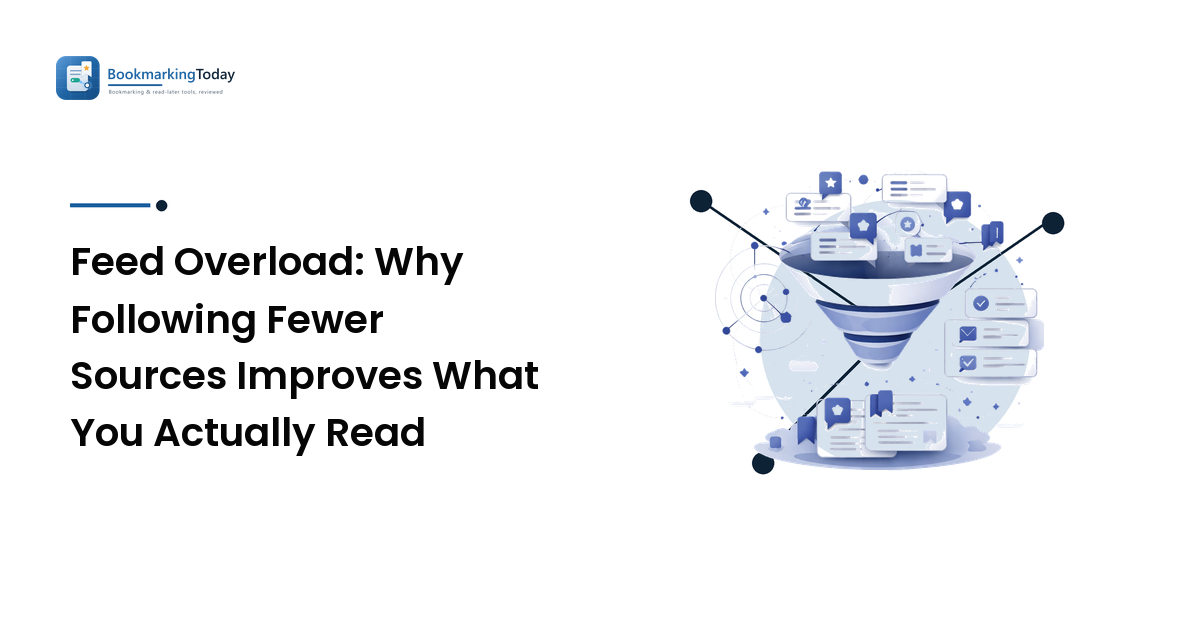
Every source you add to a feed looks free. One more newsletter, one more subscription, one more account to follow — each takes seconds to add and promises the occasional good piece. Yet people who follow a lot of sources rarely report reading better things than people who follow a few. Usually they report the opposite: more scrolling, more guilt, and a saved-link pile they never open.
The reason is not discipline. Adding sources adds volume linearly but adds attention not at all, so past a certain point every new source raises your triage cost and lowers the average quality of what you actually finish. The fix is not a willpower fix; it is a measurement fix. Once you can see which sources produce things you genuinely use, the pruning decisions make themselves.
The activity and the outcome are not the same thing
It is worth being blunt about what the outcome of reading actually is. It is not items seen. It is not items saved. It is the number of things that changed something — a piece you finished and thought about, a fact you reused, a source you cited, an idea that made it into your own work.
Following sources is the activity. Useful reading is the outcome. Almost everyone tracks the activity, because feeds display it for you: unread counts, subscription lists, saved totals. Almost nobody tracks the outcome. That mismatch is why a feed can grow for years while the reading gets worse, and nothing in the interface ever warns you.
Why more sources produces less
Three mechanisms do the damage, and they compound.
Duplication. Sources in the same field cover the same events. The tenth source in a niche mostly repeats the first three, so it adds items to triage without adding information. Your feed gets longer while your knowledge does not.
The triage tax. Every item you skip still costs something: you read the headline, judge it, and move on. That cost is small and constant, which makes it easy to ignore, and it scales directly with volume. A large feed can consume the whole reading session before anything gets read properly.
A collapsing bar. When volume is high, you stop reading and start skimming, and skimming rewards headlines rather than substance. You also start saving instead of deciding — which is how a queue becomes a graveyard. If your saved list has quietly turned into storage you never return to, that is the same failure downstream, and it needs a resurfacing habit as much as it needs a smaller intake.
Measure the outcome: a signal-rate audit
You do not need analytics software for this. You need one month and a willingness to count.
The core number is simple. For each source, over a fixed window, record:
| What to count | Definition | Why it matters |
|---|---|---|
| Items seen | Everything from that source that reached your feed | The denominator — the attention it consumed |
| Items opened | You clicked in and read past the intro | Separates a good headline from good content |
| Items saved | You kept it for later | Intent to use, not proof of use |
| Items used | You finished it, cited it, shared it with a reason, or acted on it | The only true outcome |
From those, two ratios tell you nearly everything:
- Signal rate — items used divided by items seen. What proportion of the attention this source consumed came back as something real.
- Follow-through — items used divided by items saved. Whether the things you keep from this source ever get opened again.
Do not chase a target number. There is no correct signal rate, and any figure you read as a benchmark is somebody else's reading life. The value is entirely relative: rank your own sources against each other and against their own previous month.
How to run the count without extra tools
Keep it crude on purpose, or you will stop after a week. A single spreadsheet with a row per source and four columns works. Tally as you go rather than reconstructing at the end, and include the source name in the note whenever you save something, so the "used" column can be filled from your saved library later. A month is long enough to expose a pattern and short enough to finish.
Reading the results
The interesting sources are the ones at the extremes.
- High volume, near-zero use. The clearest cut. These sources are consuming the largest share of your attention and returning nothing.
- Low volume, high use. Protect these. A source that posts rarely and hits often is the best thing in a feed, and it is exactly what gets buried by high-volume neighbours.
- High saves, low follow-through. The source produces things that look useful. Either the content over-promises, or it belongs to an interest you no longer act on.
- Everything mediocre. If nothing stands out, the problem is probably your intake channel, not the individual sources — worth reconsidering how you subscribe and triage at all, which is where choosing the right reader makes more difference than pruning.
What to do with a low-signal source
Unsubscribing is not the only move, and it is often not the right one.
Downgrade it. Move high-volume, occasionally-useful sources out of your main feed into a separate low-priority folder you check deliberately, not continuously. This preserves access while removing the triage tax from your daily reading.
Narrow it. Many sources publish across several topics. Where the platform allows a topic-specific or category-specific subscription, take it — you keep the good half and drop the rest.
Batch it. Some sources are worth reading weekly and terrible daily. Digest or summary options exist for exactly this.
Replace it. If three sources cover the same beat, keep the one with the best signal rate and drop the other two. Duplication is the cheapest thing to cut because you lose almost no information.
Cut it. For the genuine zeroes, cut without ceremony. You can resubscribe; nothing is permanent.
Rebuild around what you are trying to produce
After pruning, add back deliberately. The useful question is not "is this interesting?" — almost everything is interesting — but "what will I do with this?" Sources that feed a project, a piece you are writing, or a decision you are making have an obvious outcome. Sources you follow out of habit or professional anxiety do not.
Then re-run the count twice a year. Feeds decay: publications change editors, people change focus, your projects move on. A source that earned its place two years ago may be dead weight now, and the only way to notice is to look. This is the maintenance layer of any content discovery workflow — the part that keeps a system from silently filling with noise.
What the number does not capture
Be honest about the limits, or the measurement becomes its own trap.
Serendipity is real, and a strictly optimised feed can starve you of the unrelated idea that turns out to matter. Keep a small deliberate slot for sources outside your field, and judge them differently. Some sources also pay off slowly — a long-form publication might produce one piece a quarter that reshapes how you think, which no monthly ratio will flatter. And counting itself takes effort; run the audit as an occasional exercise, not a permanent habit.
The point is not to run your reading like a dashboard. It is to replace a feeling ("I should probably follow that") with one piece of evidence.
FAQ
How many sources should I follow?
There is no right number, because it depends entirely on how much reading time you have and how much your sources duplicate each other. The better question is whether your current list produces things you actually use. If most sources have never yielded anything you finished or reused, the list is too long regardless of its size.
Is unfollowing risky if I miss something important?
Genuinely important news in any field reaches you through several routes — colleagues, summaries, the remaining sources. The realistic cost of unfollowing a low-signal source is much smaller than the daily cost of triaging it, and resubscribing takes seconds if you were wrong.
What is the difference between a feed audit and inbox zero?
Inbox zero is about clearing a backlog; a feed audit is about reducing what enters. Clearing without pruning means you do the same work again next week. Both matter, but intake is the lever with lasting effect.
Should I measure saved links as well as feeds?
Yes, and it is often more revealing. Saves record intent, and comparing saves to actual use exposes which topics you keep telling yourself you will get to. If a tag or folder has collected items for months without a single one being reopened, that is a subject you are interested in but not acting on.
Next step
Before you unsubscribe from anything, spend one month counting. A row per source, four columns, tallied as you go. At the end you will have something no feed interface shows you: which sources gave back what they took. Cut the zeroes, downgrade the noisy, protect the rare and excellent — then decide whether your current reading setup is helping. If it is not, compare bookmarking, read-later, and RSS tools on BookmarkingToday and pick one that fits how you actually read.