You submit a link. It looks fine for an hour, or it never appears at all, and by the next morning it is gone. No message, no reason, and often no way to ask. So you submit again, maybe from a second account, and now the whole account is limited.
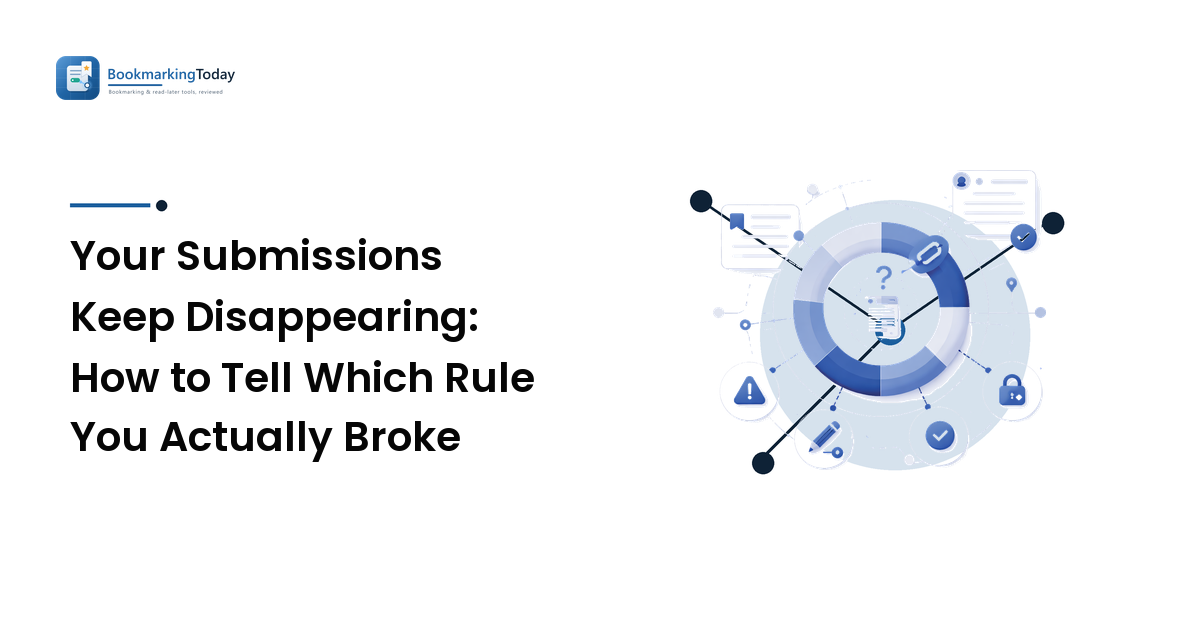
The instinct is to assume the platform disliked the link. Usually it did not even look at the link. A removed submission has four common causes, and only one of them is about the thing you submitted. The other three are your account's standing, the shape of your posting, and the page you pointed at. They need completely different fixes, and applying the wrong one — rewriting a perfectly good description when the real problem is a two-day-old account — wastes weeks and makes the pattern look worse.
Diagnose first. It takes about ten minutes and needs no special access.
The three questions that narrow it down
Before you change anything, collect the evidence you already have.
1. Did it appear and then vanish, or never appear at all?
Never appearing points at an automated filter or a moderation queue — something decided before a human or a community saw it. That is usually account standing or the destination. Appearing and then disappearing points at a human moderator or at other users flagging it, which is usually the submission or the pattern.
2. Is it only your own domain that disappears?
Submit something you have no stake in — a well-known reference page on your topic, described honestly. If that survives and your own links do not, the problem is attached to your destination, not to you. If that vanishes too, the problem is your account or your behaviour.
3. Do other people's posts of the same URL survive?
If someone else has successfully shared a page from your site and it is still up, the destination is acceptable to the platform and you have narrowed it to you. If nobody's links to that domain survive anywhere, you have found your answer.
Three checks, four possible causes. Now match.
Cause 1: The account has no standing yet
By far the most common, and the one people never suspect because it has nothing to do with the content.
Based on how these platforms generally work, new accounts are weighted differently: submissions go into a queue, are shown to fewer people, or are held until the account has some history. An account created this week, whose first action is posting a link, sits in the least trusted bucket there is. Nothing you submit from it is being judged on merit yet.
Symptoms: posts never appear publicly; everything you submit behaves the same way regardless of what it is; the same link posted from an older account is fine.
What it needs: time and participation, not better submissions. Comment, vote, and save other people's work for a while before submitting your own again. There is no way to shortcut this, and the shortcuts people try — a second account, a bought account — are exactly the signals that turn a quiet filter into a ban.
What it does not need: rewriting your title. You could submit the best link on the internet and it would sit in the same queue.
Cause 2: The pattern, not the post
Platforms are far better at spotting shapes than at judging quality. A submission can be individually reasonable and still be removed because of the pattern it belongs to.
The patterns that get noticed:
- Everything you post is from one domain. A stream of submissions that all point at the same site reads as a feed, not a participant, even when each page is genuinely good.
- Bursts. Ten submissions in twenty minutes, then nothing for a fortnight. Human curators drip; automation clusters.
- Identical text everywhere. The same title and description pasted across several platforms within the same hour is trivially detectable and is treated as a campaign.
- Posting into whatever community will accept it rather than the one the page belongs in.
Symptoms: individual posts survive at first and are removed later, often in groups; your older submissions disappear at the same time as your newest one.
What it needs: a change of cadence and mix, then patience. Space submissions out. Post other people's work more often than your own. Vary the description honestly — not to disguise anything, but because a description written for a specific audience is different from one written for everyone. If you are running submissions at any volume, the sustainable structure for that is covered in social bookmarking at scale.
Cause 3: The submission itself
Sometimes it really is the post. This is the easiest cause to fix and the least common of the four.
Check the submission against the platform's own norms:
- Is the title the page's title, or an advertisement? Rewritten, superlative-laden titles get removed on sight in most communities.
- Is the description a description, or a keyword list? If it reads like it was written for a crawler, a moderator will read it that way too.
- Is it in the right category or community? A perfectly good page in the wrong place is off-topic, and off-topic is a removable offence almost everywhere.
- Has the URL already been submitted? Duplicates are usually removed automatically, and re-submitting a duplicate looks deliberate.
Symptoms: one post removed, others fine; a removal reason that mentions the title, category, or duplication.
What it needs: rewrite honestly and post once more, in the right place. Once. Repeated resubmission of a removed item is the behaviour that escalates a removal into a restriction.
Cause 4: The destination page
The last cause sits outside the platform entirely, and it is the one that no amount of good behaviour fixes.
Some destinations get filtered regardless of who submits them: a URL that redirects two or three times before it lands, a page behind an interstitial or an aggressive consent wall, a domain that has been used for spam by a previous owner, or a page that is mostly outbound affiliate links with little of its own. Platforms make these decisions at the domain or URL level and do not usually explain them.
Symptoms: nobody's links to that destination survive, on any platform; the same submission works fine when you point it at a different page on the same site — or fails everywhere while your neutral test link passes.
What it needs: work on the destination, not the submission. Remove the redirect chain and submit the final URL. Fix the page so it has a reason to exist beyond the link. If the domain itself carries history, that is a longer project. The checks worth running on any page before you promote it anywhere are in what has to be true before a link does anything.
What to do while you are unsure
Three rules that hold whichever cause you have:
- Stop submitting until you know. More submissions during a bad patch add evidence for the pattern reading, and they cost you the clean baseline you need to test anything.
- Never make a second account. Where evasion is detectable — and it usually is — it converts a recoverable filter into a permanent one.
- Ask, once, where asking is possible. Some platforms have a moderator contact or an appeals form. A short, non-defensive message asking what rule was broken is answered more often than people expect, and the answer saves you the diagnosis.
And if two platforms in a row filter you while the third does not, that is information about fit rather than about your links. Choosing places where your topic is genuinely active is half the problem solved before it starts: see how to choose the bookmarking sites worth your time and the social bookmarking guide for the wider picture.
FAQ
Why was my post removed with no reason given?
Most removals are automated or done in bulk by volunteer moderators, and neither generates an explanation. The absence of a reason is not a signal about severity — it is the normal case.
Does a removed submission hurt my site?
No. A link that never became public simply does not exist as far as search is concerned. The risk is behavioural: repeated resubmission and evasion can get the account restricted, which closes the channel entirely.
Should I delete my other submissions after one is removed?
Usually not. Deleting in bulk looks like cleanup and does not undo anything the platform has already recorded. Leave them, change what you do next, and let the account age.
How long should I wait before submitting again?
Long enough for the account to have done something other than submit. A week or two of ordinary participation is a reasonable rule of thumb, and there is no published number because platforms do not publish one.
Is it the nofollow attribute causing removals?
No. Link attributes affect what search engines do with a link that exists; they have no bearing on whether a moderator or filter keeps your submission.
Removals feel personal and almost never are. Work out which of the four causes you have — standing, pattern, submission, destination — before you touch anything, because three of the four are not fixed by rewriting your post, and one of them is not fixed on the platform at all. For more on running bookmarking and submissions in a way that keeps working, read the guides at BookmarkingToday.