The pile is easy to picture because you probably have one: years of saved links in a sidebar you never open, folders named in a hurry, and a search habit that ends at a search engine instead of your own collection. When you need the page you saved, you go looking for it on the open web all over again — which means the bookmark did no work at all.
The tempting conclusion is that organizing bookmarks is pointless now, because searching again is free. It is not. What you saved is the product of judgment you already spent: the comparison that was actually fair, the documentation page that actually answered the question, the write-up you trusted after reading four you did not. Search the open web again and you get the unfiltered pile back, ranked by whatever happens to rank today. A findable bookmark returns the decision, not just the page.
So the question worth answering is not "how do I tidy my bookmarks" but the one underneath it: how do you organize saved links so they are still findable when you have forgotten everything about the day you saved them? Forgotten which folder you chose, forgotten the words in the title, sometimes forgotten that you saved it at all. Every part of a bookmark system that works is an answer to that day. Every part that fails was built for the day you saved, when you still remembered.
This guide is the map of that system — one home, structure that does not lean on memory, names your future self can search, and a little maintenance — with a deeper guide waiting at each stop.
What "organized" actually means
Forget tidy. A collection is organized when you can get from "I know I saved something about this" to the open page in under a minute, by whatever route your future self would naturally try: typing a word into search, opening a tag or folder that obviously fits, or scanning recent saves. That is the retrieval test, and it is the only standard worth holding.
Tidiness and findability are different qualities that merely look alike. A beautifully symmetrical folder tree that fails the retrieval test is decoration. A flat, unglamorous pool of well-named, well-tagged links that passes it is organized, whatever it looks like. Every choice below is judged against the test, not against how the sidebar photographs.
One home, chosen on purpose
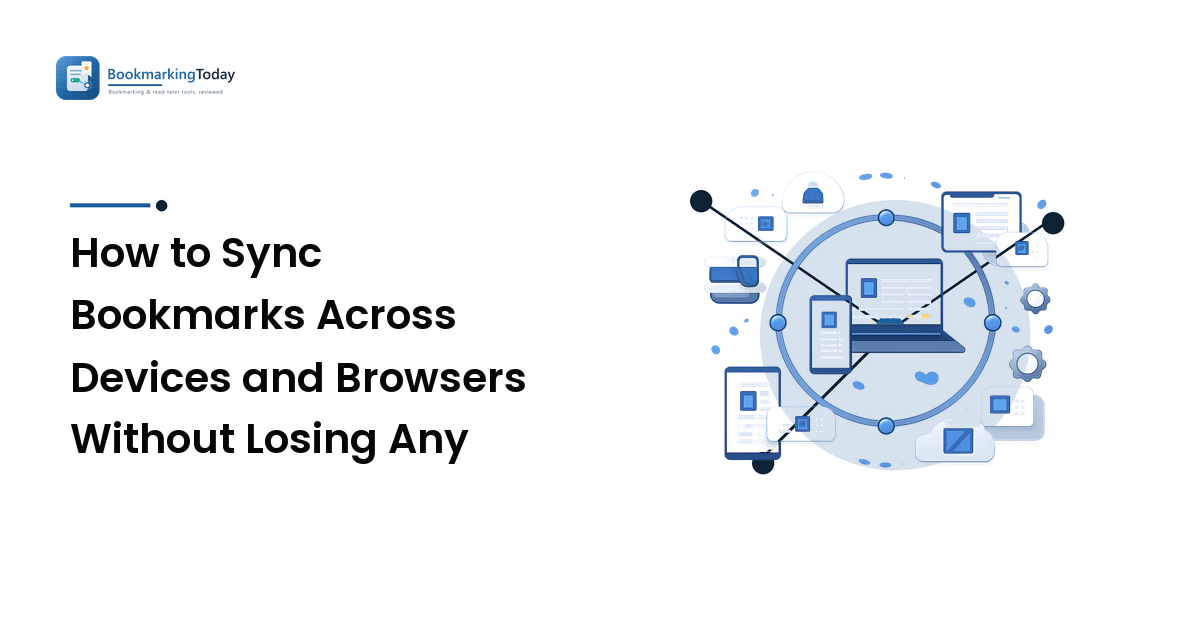
Fragmentation defeats organization before it starts. If your links are split across a work browser, a personal browser, a phone, and a notes app, no filing scheme can save you — you cannot find a link when you are not sure which library to search. So the first decision is not folders or tags. It is where your links live: one place, reachable from every device you actually use.
For most people the genuine contest is between the browser they already have and a dedicated bookmark manager, and the honest answer depends on volume and how many devices are involved — browser bookmarks vs a bookmark manager walks the line properly. The reasons to move up are concrete: better search, real tags, and a library that follows you rather than the browser. The reason to stay put is simplicity. Either can pass the retrieval test. Split custody cannot.
Structure that survives forgetting
Here is where most systems quietly fail. The instinct is folders, and then more folders — but a folder forces every link into exactly one place, and you choose that place using context that lives only in your head on the day you save. Future-you does not have that context. Future-you looks in a different, equally sensible folder, finds nothing, and gives up.
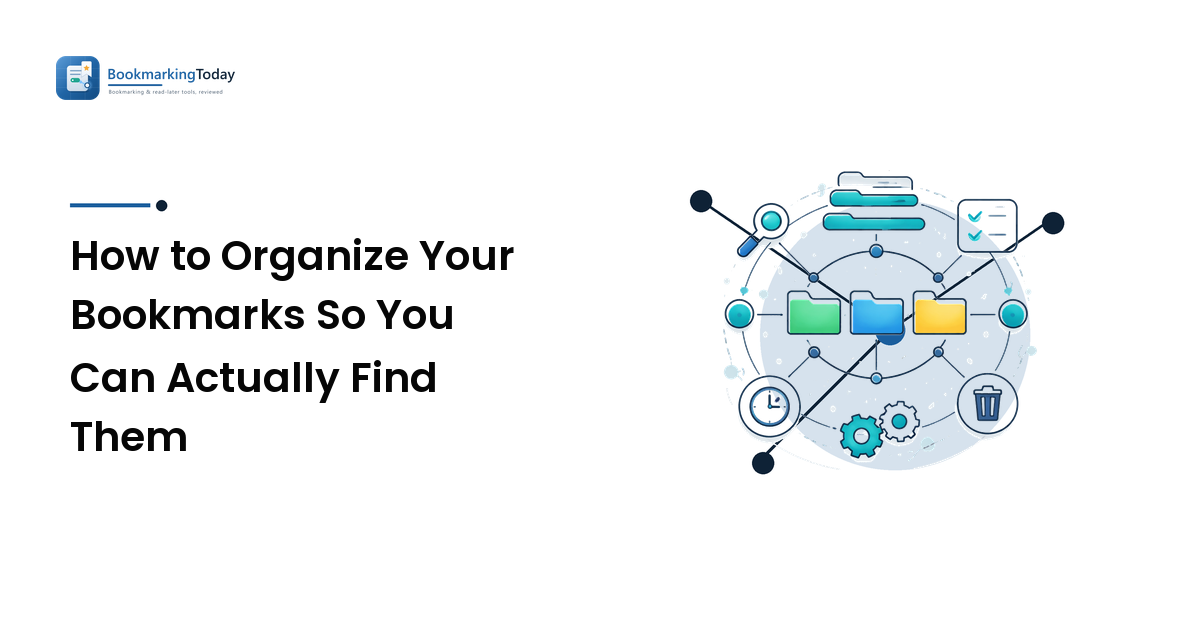
Structure survives forgetting when it is keyed to what a page is about rather than where it ought to live — several tags instead of one folder, so the page surfaces from whichever angle you approach it later. Why the graveyard forms and how the folders-plus-tags fix works is covered in why bookmarks become a graveyard; if you want the full working setup — buckets, a shallow folder skeleton, and the routine that keeps it running — how to organize your bookmarks builds it step by step.
One habit belongs here because it costs ten seconds and rescues more links than any scheme: rename the bookmark when you save it. Pages arrive with titles written for the site's purposes, not yours, and a link labeled with boilerplate is half-lost the moment it is filed. Put the words you would search into the name while you still know what they are.
The maintenance nobody budgets for
An organized collection decays in two silent ways, and neither announces itself.
The first is that the web moves underneath you. Pages get deleted, moved, and rewritten, so some of your links now point at nothing — and every dead link makes the collection feel less trustworthy, which makes you search it less, which makes the whole system rot socially before it rots technically. Why that happens and what to do about it is in why your saved links break.
The second is losing the collection itself. Sync feels like safety but is only a mirror: it copies deletions and corruption to every device just as faithfully as saves. The fix is an occasional exported copy that lives outside the tool — the mechanics are in how to back up your bookmarks. It is the least interesting part of the system and the only one that can save all the others.
The inflow problem
There is a stage before saving that most organization advice skips: the wall of open tabs. Every tab kept open "to deal with later" is a bookmark that has not happened yet, held in the most fragile storage available. If your pile begins life as forty tabs that eventually get dumped into a folder called misc, the filing system never had a chance. Turning that inflow into deliberate saves is its own small discipline, covered in how to tame too many open tabs.
The trade-offs the category hides
- Everything you add at save time is paid on every save. A ritual that takes two minutes per link produces a beautiful library of the twelve links you bothered to file. The workable system is deliberately cheap at the moment of saving — seconds for a name and a couple of tags — and rich at the moment of searching.
- Designing a taxonomy feels like progress and retrieves nothing. An afternoon spent perfecting category schemes is procrastination in its Sunday clothes. A rough structure used consistently beats an elegant one used twice.
- Switching tools does not organize anything. A mess imports perfectly. Move homes when the current one genuinely fails the retrieval test, not because a new tool promises that this time will be different.
- Organizing for appearance serves the person filing, not the person searching. The neat tree comforts you today; the searchable name rescues you next year. When the two conflict, the future reader wins.
Start where it hurts
You do not have to build all of this at once, and you should not start with the part that is most fun. Start with the failure you actually have. Links you know you saved but cannot find: fix structure and naming first. Links scattered across browsers and devices: fix the home first. A cold fear of losing years of saves: do the backup today. A pile so old it shames you: run the cleanup and the folders-vs-tags fix before adding anything new. Each fix stands alone, and each makes the next one easier.
FAQ
Is organizing bookmarks still worth it when I can just search the web again?
Yes, because re-searching returns a page on the topic while your bookmark returns the page — the one you vetted, in the version you read. The judgment you spent choosing it is the value; organization is just what keeps that judgment retrievable.
Should I use folders or tags?
Tags carry the weight, because a page can be about several things and tags let it live in all of them; a few broad folders are fine as coarse shelves. The fuller argument, and the fix for a pile that folders already ate, is in the folders-vs-tags guide above.
How often does a bookmark collection need cleaning up?
On a cadence you will actually keep — brief and regular beats heroic and rare. The signal that you have waited too long is distrust: when you stop searching your own library because you expect dead links and junk, the cleanup is overdue.
My bookmarks sync across devices. Do I still need a backup?
Yes. Sync mirrors your library everywhere, including every deletion and mistake, so it protects you from a lost device but not from a lost collection. An exported copy stored outside the tool is the only version that survives everything.
Next step
Pick the failure that stings most and fix that one this week — the home, the structure, the names, or the backup. Then let the retrieval test judge every change: saved once, found in under a minute, on the day you remember nothing. For more ways to make saving, organizing, and discovering links actually pay off, keep reading at BookmarkingToday.